

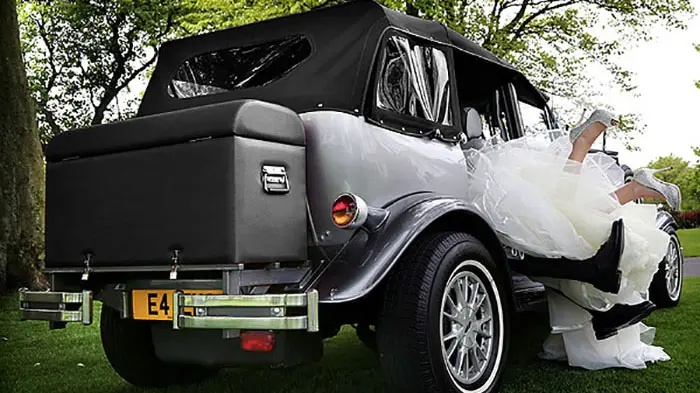
Since 1996, we’ve arranged wedding transport for over 30,000 brides.
“Will my wedding dress fit in the car?” is still one of the first questions we hear once the dress is chosen.
The short answer: it depends on five things. Your skirt shape, the door opening, the step height, the seats and roof line, and who sits where.
We work with independent vehicle suppliers, so we see a wide range of cars and dresses. This guide shows you how to check each of those five things, how to get in and out, and what to photograph and film at a viewing.
The dress and the car in numbers
42 to 60 inches
Width of a hooped ball gown at its widest.
22 to 24 inches
Rear door opening of a four-door Beauford.
13 to 14 inches
Ground to floor in a modern Rolls-Royce Phantom. No step.
95%
Of the cars we offer have a front passenger seat available.
11.2 minutes
Average journey from collection to ceremony in our bookings.
Car figures are our own measurements.
1. Know what your skirt shape needs
Your skirt shape decides how much seat width you need and how easily you can bend.
A hooped ball gown can measure about 42 to 60 inches (107 to 152 cm) across at its widest. That’s wider than any car door opening in this guide, so the skirt has to be gathered as you sit.
A ball gown needs width. A mermaid dress needs room to move your knees. A long train needs floor space and a careful door.
Here’s what to check for each:
Ball gown or hooped skirt
Matters most: rear seat width and door width.
Check: bench width, seat shape, and whether a second passenger still fits.
A-line
Matters most: door width.
Check: how far the door opens.
Mermaid or fit-and-flare
Matters most: knee and leg movement.
Check: step height and seat height.
Chapel or cathedral train
Matters most: floor space, and the door catching it.
Check: footwell space, and who will tuck the train in.
Cathedral veil or tall headpiece
Matters most: headroom at the door and over the seat.
Check: roof height at the door, and whether the roof slopes down over the rear seat.
Boned or corseted bodice
Matters most: bending forward.
Check: roof height and seat height.
Before the viewing:
- Ask your bridal shop for the skirt width at its widest point.
- Note the train length and whether it bustles.
- If you send us photos of the dress, add the measurements. Photos on their own can be misleading.
The wedding car may be the first place you sit down in your dress. Rehearse it at your bridal shop first, so you know how much the dress lets you move.
At your next fitting:
- Ask for a chair or bench without arms.
- Sit on the edge first, then slide back, as you would in the car.
- Lift both knees together and turn to one side, to see how far the skirt lets you move.
- Lean forward as if ducking under a roof edge, and check how far the bodice lets you bend.
- Practise gathering the skirt onto your lap.
- Wear the petticoat or hoop, and shoes with a similar heel height to your wedding shoes.
Worried about a large ball gown? Tell us when you enquire, not after you book.
2. Check the door opening
The door decides how you get in, before the cabin space even matters.
Most cars have front-hinged doors. You step in past the door edge and turn to sit.
Some cars have rear-hinged coach doors, which open from the back. Most modern Rolls-Royce models have them, and so do some classic cars from other makes, such as the Austin Princess limousine.
For example, here are measurements we took on three popular cars:
- Modern Rolls-Royce Phantom: the rear coach doors open to nearly 90 degrees. The rear door opening is about 39 to 43 inches on the standard wheelbase and about 49 to 53 inches on the extended wheelbase. The extra 8.6 inches of the extended car is all in the rear compartment.
- Four-door Beauford: the rear door opening is about 22 to 24 inches.
- Bentley Mk VI: front-hinged doors with an opening of about 26 to 28 inches, and a door height of about 45 inches.
Here’s how:
- Open the door fully and check whether it holds open on its own.
- Measure the opening at seat height, side to side.
- Measure the height of the opening, from the sill to the roof edge.
- Check nothing sticks out into the opening, such as a door pocket or handle.
Measure the gap you’ll step through, not the cabin behind it.
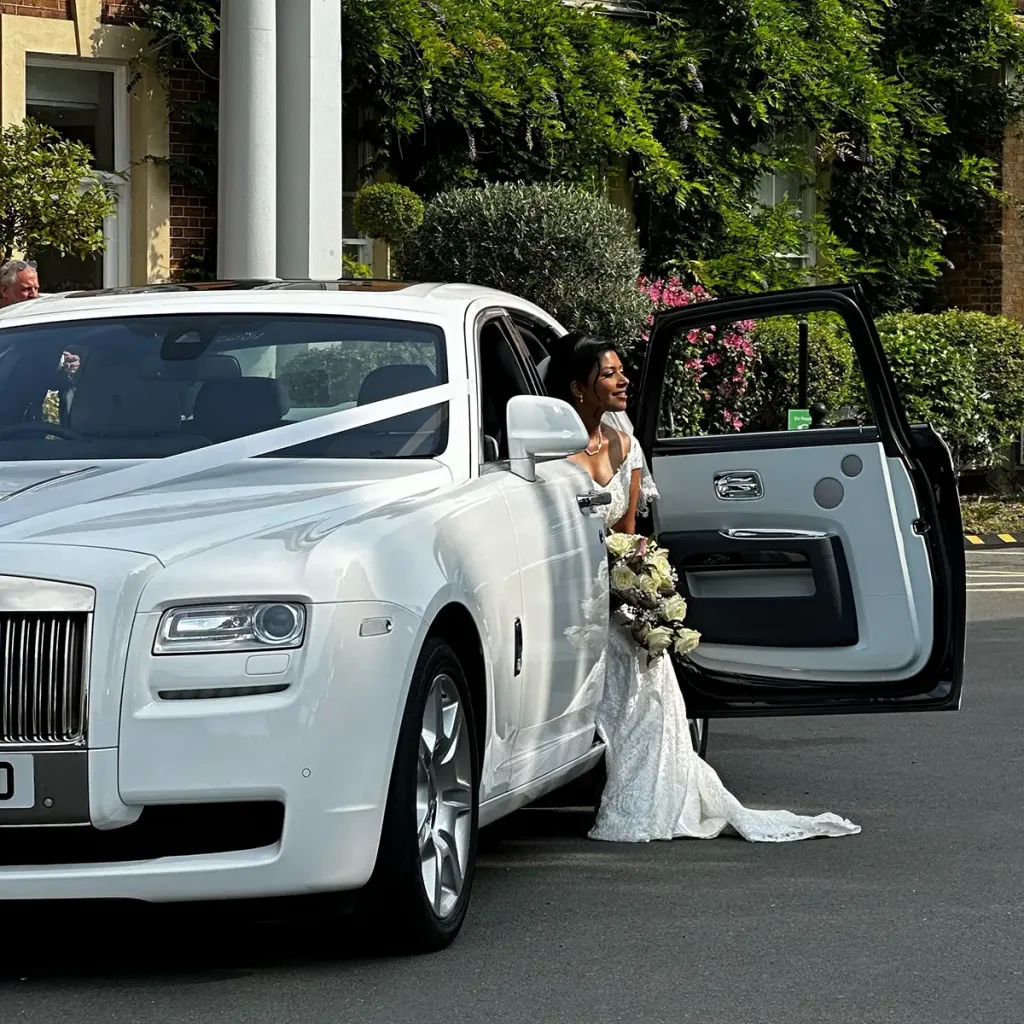
Rear-hinged coach doors open from the back, leaving a wide gap to step through.
3. Check the step height
A high step is harder in a fitted dress. A very low seat is harder in a boned bodice.
Many vintage-style cars, such as the Beauford and the Bentley Mk VI, have running boards. They work well in photographs, but they add a step up before you reach the floor of the car.
Here’s how three cars compare, from our own measurements:
Modern Rolls-Royce Phantom
Ground to step: no step
Ground to floor: 13 to 14 inches
Beauford
Ground to step: running board, 11 to 12 inches
Ground to floor: 17 to 18 inches
Bentley Mk VI
Ground to step: running board, 12 to 13 inches
Ground to floor: 19 to 20 inches
The Phantom’s floor sits lower than the Bentley’s running board step. That’s a big difference in a fitted dress.
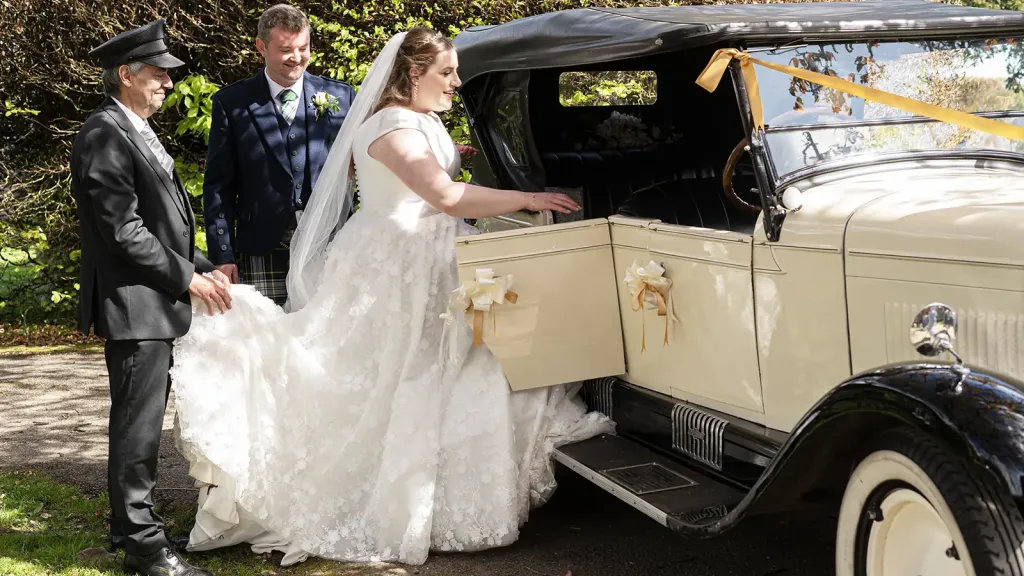
A running board adds a step up. Here the chauffeur keeps the skirt clear while the bride steps in.
Here’s how:
- Measure from the ground to the step, and from the ground to the car floor.
- Try the step in shoes with a similar heel height to your wedding shoes. If you don’t have any with you, step up as if you were wearing heels.
- Ask the chauffeur for a hand at the door. They’ll help if asked.
- In a fitted dress and worried about the height? Let us know, and a small step stool can be brought along.
A fitted dress suits a low step. A running board needs a steady hand.
4. Check the seats and the roof line
Once you’re through the door, the seat shape and the roof decide how much room the skirt and veil have.
Most wedding cars have a flat rear bench, which lets a full skirt spread across the seat. Some don’t:
- Semi-bucket seats: some classic sports cars, such as the Aston Martin, have 2 shaped seats that hold you in place. They leave less room either side for a full skirt, and with only 2 doors, getting in is harder in a larger dress.
- Fixed armrests: some modern Rolls-Royce Phantoms have a fixed armrest in the middle of the rear seat. That makes it 2 rear seats, not 3, and splits the space the skirt can use.
The roof matters too. Some classic saloons have a roof that slopes down towards the rear seat, so there’s less headroom as you bend in and once you sit. Older vintage cars tend to have a squarer rear, which gives more headroom for a veil or tall headpiece.
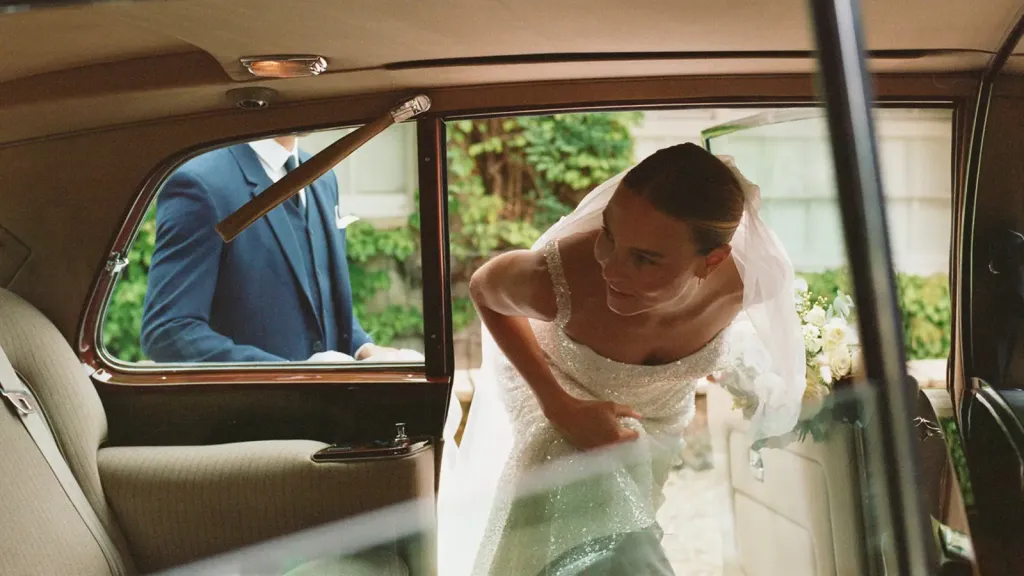
Going in head first means bending low under the roof edge. Sitting first, then lifting your legs in, is easier in a full dress.
Here’s how:
- Ask whether the rear seat is a flat bench or shaped seats.
- Check for a fixed armrest in the middle of the rear seat.
- Look at the car from the side and see whether the roof slopes down over the rear seat.
- Sit in the rear wearing your headpiece, or a veil comb, and check the roof edge as you bend in.
A flat bench and a square roof give a full skirt and a tall veil the most room.
5. Decide who sits where
Moving one passenger to the front seat can free the whole rear seat for the dress.
95% of the cars we offer have a front passenger seat available. For example, our classic Rolls-Royce Silver Cloud has 1 front passenger seat and 3 rear seats.
If the car seats three in the rear and the bride is travelling, we’d always take one passenger out, whatever the size of the dress. For the largest gowns, the bride has the rear to herself and the person giving her away sits in front.
Seat belts matter for the dress too. If a seat has a belt fitted, you’ll need to wear it. Some classic and most vintage cars have no rear seat belts, so there’s no belt across your dress. The Silver Cloud, for example, has a seat belt in the front only.
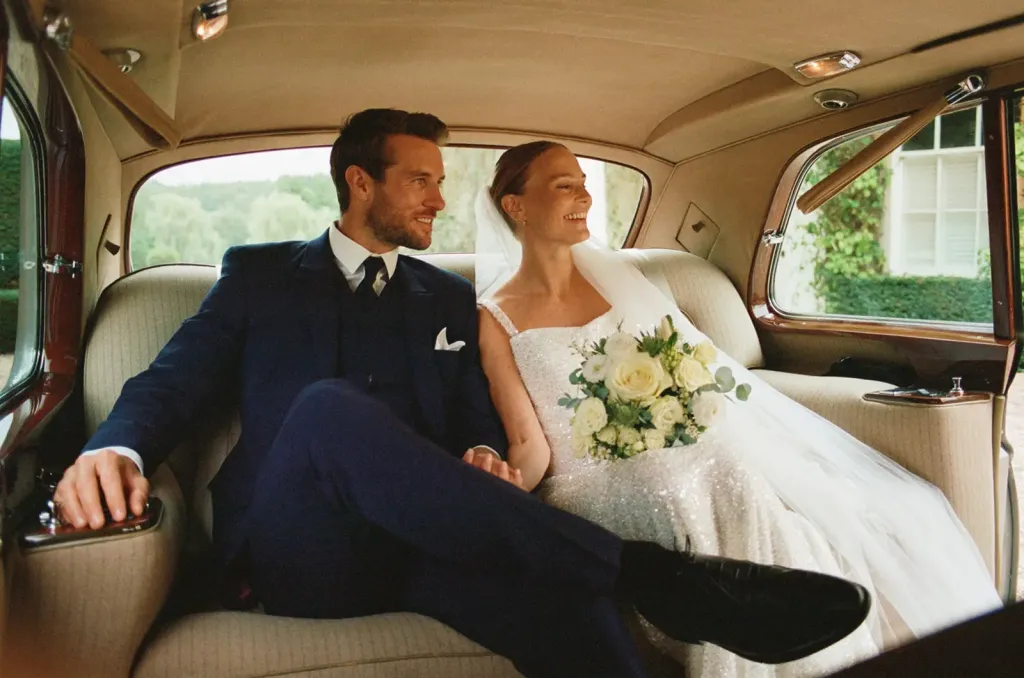
Two in the rear leaves room for the dress. Three would not.
Here’s how:
- Check “Passenger seats” on the vehicle page, and the seat belts if that’s important to you.
- Ask whether the front seat moves forward to give more rear legroom.
- If bridesmaids are travelling too, ask us about a second car or a second journey.
Plan the seating around the dress, not the other way round.
6. Get in and out the easy way
Most of the risk to the dress happens at the door, not on the road.
To get in:
- Stand with your back to the open door, as close to the seat as you can.
- Sit on the edge of the seat first.
- Lift both legs in together while a helper lifts the hem clear of the sill.
- Slide back and gather the skirt onto your lap or the spare seat.
- Lay the train over the top last.
- Ask your helper to check nothing is in the door frame before it closes.
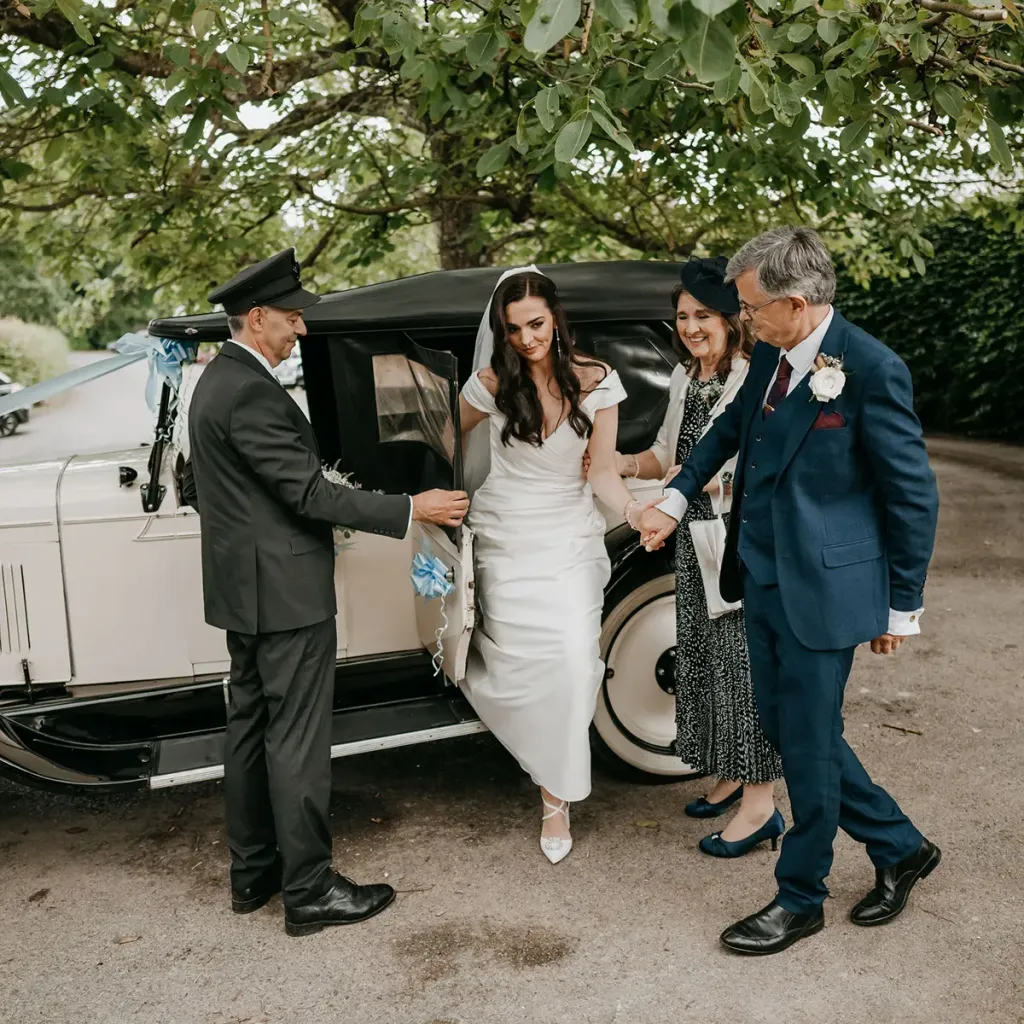
Feet out together, then stand in one movement with a hand on each side.
To get out:
- Bring both feet out together and place them on the ground or step.
- Take the chauffeur’s hand, or the hand of the person travelling with you, and stand in one movement.
- Let your helper lift the train clear before you walk away.
Getting out is usually when the photographer is waiting, so it’s worth practising.
On the day, watch the door itself. Some classic and vintage cars have mechanical door locks that are greased to keep them working, and rear-hinged doors can have greased hinges. Keep the dress clear of both as you get in.
Practise both at the viewing, and ask someone to film it. That’s it.
7. How to check your wedding dress will fit in the car at a viewing
Photos and a short video from a viewing give your dress fitter something to work with. They also remind you how much space there is.
If you’re worried about space, let us know when you’re ready to book. We’ll get the dimensions of the actual car and, where possible, arrange for you to view it. Here’s how to book a viewing.
Take these photos:
- The door fully open, from the side.
- A tape measure across the door opening at seat height.
- A tape measure from the ground to the step.
- The rear seat, taken from the open door, to show whether it’s a bench or shaped seats.
- The footwell, to show legroom.
- The front passenger seat, and how far it moves forward.
- The roof edge at the door, for veil and headpiece height.
- The car from the side you’ll arrive on, to show the roof line.
Then film it:
- Ask someone to film you getting in, sitting down and getting out.
- Bring the petticoat or hoop if you can, and wear it for the video.
- Show the video to your dress fitter with your skirt measurements.
- Watch it again before the day, so you remember the space and the order of the steps.
Last of all, ask the supplier which door you’ll use on the day.
Eight photos, one short video and a tape measure answer most of the questions.
8. Compare the actual cars, not the model name
No single car suits every dress. Two cars of the same model can have different seats, doors and step heights. The Beauford, for example, comes as a two-door or four-door car.
Here are some examples from our website:
Austin Princess limousine
Doors: rear-hinged rear doors
Step: no running board
Seating: up to 7 passengers. With 2 in the rear, the occasional seats fold away and the rear cabin is very large.
Suits: a full skirt. If bridesmaids travel with the bride, keep it to 2 on the rear bench, not 3.
Rolls-Royce Phantom (modern)
Doors: rear-hinged coach doors
Step: no running board. Floor 13 to 14 inches.
Seating: mostly 3 in the rear. Some have a fixed rear armrest, so only 2.
Suits: easy access.
Classic Rolls-Royce Silver Cloud
Doors: front-hinged
Step: no running board
Seating: 1 front, 3 rear
Suits: the bride in the rear with one passenger in front, or 2 in the rear and 1 in front. Not 3 in the rear with the bride.
Beauford convertible
Doors: front-hinged, two-door or four-door
Step: running board, 11 to 12 inches
Seating: 2 in the rear, especially if the bride is travelling
Suits: photos. Check the step in a fitted dress. With the roof down in good weather, getting in and out is easier.
Bentley Mk VI
Doors: front-hinged
Step: running board, 12 to 13 inches
Seating: normally up to 3 in the rear, but only 2 if the bride is travelling in the rear
Check first: the door opening, about 26 to 28 inches wide and 45 inches high.
Classic Aston Martin
Doors: 2 doors only
Step: no running board
Seating: 2 semi-bucket seats
Suits: a slim dress. Access is harder in a larger dress.
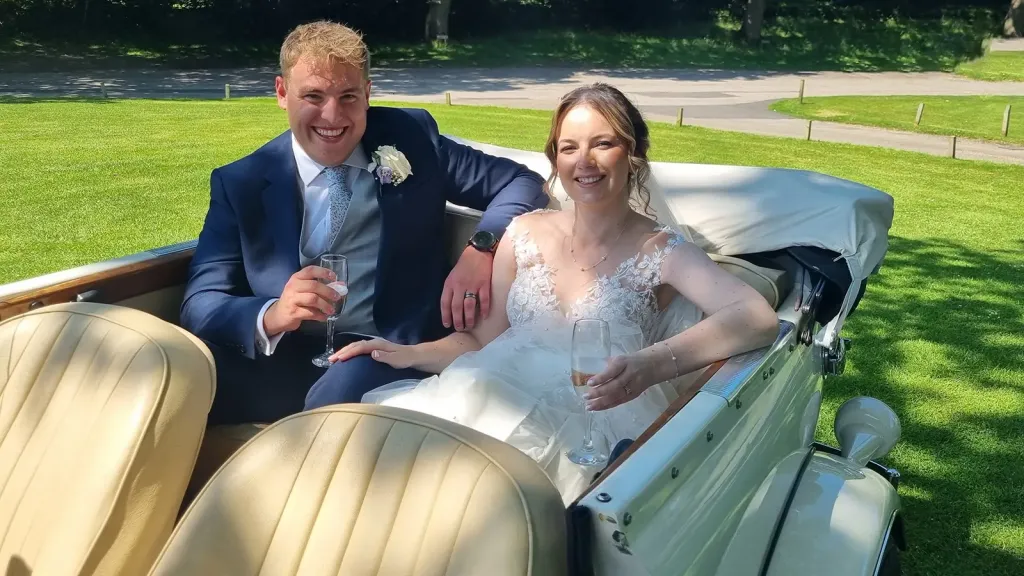
With the roof down in good weather, there’s no roof edge to duck under.
These are our own measurements of some popular cars. If you’re worried about space, let us know when you’re ready to book and we’ll get the dimensions of the actual car.
Judge the car in front of you, not the brochure.
9. Protect the dress on the journey
The journey itself is short, so most of the care happens before you set off.
Over the last 12 months, the average journey in our bookings from collection to ceremony was 11.2 minutes. Not long, but enough for some fabrics to crease if you sit on the skirt.
Here’s how:
- Gather the skirt onto your lap or the spare seat, so you sit on as little of it as you can.
- Keep drinks and make-up out of the car until the dress is safely inside.
- Ask your bridal shop which way the fabric creases least when seated.
- For winter weddings, see our winter wedding car hire guide on wet ground and sheltered boarding.
A careful door and a gathered skirt protect the dress more than anything else.
Pick two or three and start with those today. Measure the dress, practise sitting down at your next fitting, and film yourself getting in at a viewing.
Frequently asked questions
Can a ball gown fit in a vintage car?
Often, but it depends on the car. Check the rear seat width and door opening of the exact car, and plan for fewer passengers in the back. Ask us for the details before you book.
Should the bride sit in the front or the back?
Usually the back. 95% of the cars we offer have a front passenger seat, so the person giving you away can sit there and leave the dress the whole rear seat.
Which wedding car is best for a big wedding dress?
No single car suits every dress. Look for a wide door opening, a low step, a flat rear bench and a rear seat you can have to yourself, then check those on the actual car.
Should I practise sitting down in my wedding dress?
Yes. The car may be the first place you sit in the dress. At a fitting, practise sitting on the edge of a chair, turning your knees and leaning forward, wearing the petticoat and shoes with a similar heel.
Will my veil or headpiece fit under the roof?
Usually, but check the roof line. Some classic saloons have a roof that slopes down over the rear seat, while older vintage cars tend to have a squarer rear with more headroom. Sit in the car with your headpiece at the viewing.
Can we view the car before booking?
If you’re worried about space, let us know when you’re ready to book. We’ll get the dimensions of the actual car and, where possible, arrange a viewing. Read more on how to book a viewing.
Can the chauffeur help me in and out?
Yes, the chauffeur will help if asked. If you’re in a fitted dress and worried about the step, let us know and a small step stool can be brought along.
What if my dress and bridesmaids won’t all fit?
Book a second car, or a second journey, for the bridesmaids. Ask us when you enquire so it can be checked for your date.