

Winter in numbers
What we saw in our own enquiries last winter, compared with June.
105 days
Average notice for a December Saturday enquiry.
June: 225 days.
Nearly 3×
As many enquiries for December as for January.
1 in 10
Car types requested in winter were convertibles.
June: almost 3 in 10.
4 in 10
Winter enquiries were for Monday to Friday weddings.
Under 0.2%
Of winter enquiries ended in a weather cancellation.
None in December.
Based on Premier Carriage enquiry data.
Winter couples start looking for wedding cars much later than summer couples. For a Saturday wedding last December, the average enquiry reached us 105 days before the date. For June, it was 225 days.
That gap matters. December was our busiest winter month by far, so many couples are looking for the same cars in a short space of time.
This guide covers 11 checks, from booking festive dates and keeping warm in the back seat to ground conditions and refunds.
1. Book winter wedding car hire early for festive dates
December is the busiest winter month by a wide margin.
Nearly 3× as many enquiries for December as for January last winter.
December couples also left it latest:
How far ahead couples enquired
Average days between enquiry and a Saturday wedding
Winter months in purple, June in lilac for comparison.
More couples searching closer to the date means more competition for the same cars.
January and February are much quieter. January enquiries were around a tenth of June’s.
Here’s how:
- Confirm your date and venues first.
- Check availability for your exact date and collection postcode as soon as you can, especially for December.
- If you want two matching cars, check both before you commit to either.
- If your date is flexible, look at January, February or a weekday. More than 4 in 10 of our winter enquiries were for Monday to Friday weddings. Choice and prices vary by vehicle.
For December, check availability before you settle on a car.
2. Choose a car that suits your winter plans
An enclosed car is the practical choice for rain and draughts.
Most winter couples agree:
1 in 10 car types requested last winter were convertibles, compared with almost 3 in 10 in June.
A Rolls-Royce Phantom and a classic Rolls-Royce Silver Cloud both have enclosed bodywork. Heating and cabin comfort still vary from car to car.
A Beauford convertible or Imperial Landaulette can still work in winter with the roof closed. Some folding roofs seal less well than fixed ones, so you may feel a draught.
Before you book:
- Pick the style you like.
- Ask us whether the roof is fixed or folding.
- For a folding roof, ask about draughts, rain protection and any winter restrictions.
The cars named here are examples from different areas. We’ll show you what’s available near your postcode.
Choose the style, then confirm the features.
3. Check warmth where you will actually sit
A heater at the front does not always mean a warm back seat.
In some classic cars, warm air comes mainly from the dashboard. Some vintage cars have no heater at all.
Ask us to confirm three things:
- Whether the heating reaches the rear seats.
- Whether the car can be warmed before collection.
- Whether blankets are provided.
We check with the vehicle supplier rather than guessing from the model name.
Rear-seat warmth matters most on a longer journey.
A tip from Didier
Keep the vintage car for the moment that matters
If you’ve set your heart on a vintage car for your photographs but you’re worried about the cold or the weather, it doesn’t have to do every journey.
Travel to the venue in a warm, modern car. Then have the vintage car meet you just round the corner, so you can make your final entrance in it and have your photographs taken.
You still get the arrival and the pictures, without a long, cold journey in an older car. If the weather turns, there’s less to rearrange too.
Ask us about a short hire of one or two hours alongside your main car. Minimum hire times vary by supplier, so we’ll check what’s possible for your date.
Didier Di Mario
Managing Director, Premier Carriage
4. Keep the walk to the car short
The last few steps to the car need as much planning as the drive.
In a shower, a covered doorway next to the car is more useful than a parking spot across a wet courtyard.
Here’s how:
- Agree the collection and drop-off points with your venue.
- Ask us whether umbrellas and chauffeur assistance come with your chosen car.
- Bring a wrap or coat, and wear shoes with some grip.
- Ask one person to keep the dress train off wet ground.
- Pass the same advice to bridesmaids and guests moving between venues.
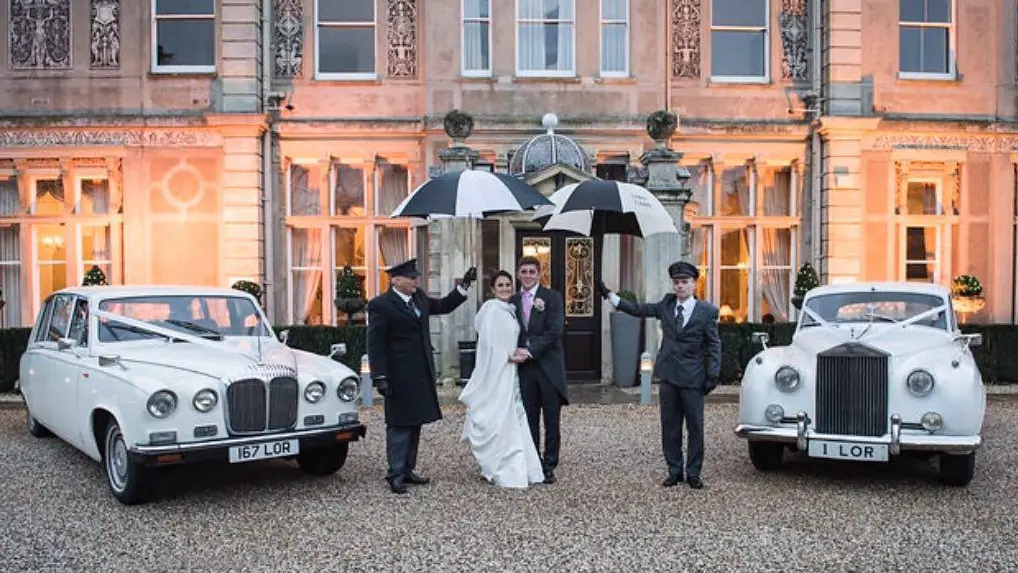
Plan the walk from the door, not just the drive.
5. Keep to the agreed photograph time
Winter daylight gives you a short window for outdoor photographs.
If you marry at a church and have photographs at the reception, the journey uses part of that window.
What to agree with your photographer:
- A photograph time you both keep to.
- Time for the journey and for greetings before you leave the ceremony.
- When the car hire ends.
- A sheltered spot in case it rains.
Dusk photographs can work well with the right lighting. Ask your photographer about both options.
Agree the light, the location and the car timings together.
6. Allow time for slower winter journeys
A route that runs on time on a dry day can take longer in heavy rain or ice.
The Highway Code advises allowing more time for journeys in ice and snow. Extra time cannot make an unsafe route safe.
Many older vehicles lack anti-lock brakes and electronic stability control, so their suppliers may plan more cautious timings. Modern cars must slow down in poor conditions too.
Here’s how:
- Tell us about every journey, including second collections.
- Agree a buffer for your route rather than a standard allowance.
- Confirm waiting time and overtime charges before you book.
One car doing two trips means one delay affects both.
Set the buffer for your route, not for weddings in general.
7. Keep the car on firm ground
A lawn can look firm and still be soft after several days of rain.
A dry wedding morning does not make it safe to drive on.
Here’s how:
- Agree a firm-surface spot with the venue and the vehicle supplier.
- Use a driveway or paved courtyard for photographs.
- Ask the venue who will grit icy paths, clear standing water and light the route after dark.
- Agree a back-up drop-off point in case the usual entrance is unsuitable.
Confirm the ground before you plan photographs on grass.
8. Check evening hire before you book
A winter afternoon arrival and a late evening return have different requirements.
Some classic and vintage suppliers restrict after-dark hire, particularly on unlit rural roads.
Lighting, any upgrades and the supplier’s policy all play a part. A city route under streetlights may be fine where a country lane is not.
When you enquire:
- Include the finish time and return route.
- Ask whether the same car can cover both journeys.
- If not, ask us about a separate vehicle for the evening.
Mention the evening journey at the start, not after you’ve booked.
9. Agree a plan if severe weather is forecast
Snow or ice can stop a classic or vintage car from travelling. Severe weather can make modern-car journeys unsafe too.
Your vehicle supplier makes the final decision on whether a journey can go ahead safely. Keep their contact details to hand in the week of the wedding.
Here’s how:
- Review the forecast with your supplier in the days before the wedding.
- Agree one main contact for the day.
- Agree when the plan will be reviewed and who will call whom.
- Discuss changes to the route, pickup point or vehicle. These depend on safe conditions and availability.
That’s it. Know who will call you, and when.
10. Know what happens if your supplier cancels
You should know who provides your car and who is responsible if it can’t be supplied.
Premier Carriage arranges your booking as agent. Your independent vehicle supplier provides the car and chauffeur, and holds the hire contract with you.
Weather cancellations are rare:
Under 0.2% of our winter enquiries ended in a weather cancellation last winter, and there were none in December.
If the supplier cancels before the hire because extreme weather makes travel unsafe, and you don’t agree to a replacement, the supplier must refund your transport payments, including your deposit.
The only possible deduction is a fair, itemised charge for personalised items you ordered that have already been made, such as printed ribbons. Those items must be given to you.
For example: ribbons you requested that haven’t been printed would not justify any deduction.
A force majeure clause does not, by itself, let a supplier keep your payment. If part of your journey has already taken place, the refund position is different.
If you need to follow up:
- Contact your vehicle supplier first. The refund comes from them.
- If you need help reaching them or chasing a refund, contact us.
- Read our Terms of Hire for the full position.
Check the refund terms as part of your booking decision.
11. Make your winter transport checklist
Before you finalise your plans, check:
- Your date is available and the car’s heating and roof suit your journeys.
- You have a wrap, shoes with grip and someone to help with the dress train.
- Your photographer knows the car timings and has a wet-weather option.
- Journey buffers, firm ground and any evening restrictions are agreed.
- You know the weather contact plan and who handles a refund.
Pick two or three and start with those today. Once your date and venues are confirmed, check live availability, then ask us about winter arrangements for the cars you like.
Frequently asked questions
How far ahead should we book a winter wedding car?
As soon as your date and venues are confirmed. Last winter, couples enquired about 105 days ahead for a December Saturday, compared with 225 days for a June Saturday. December is the busiest winter month, so earlier gives you more choice.
Do classic and vintage wedding cars have heating?
Some do, but it varies. Some classic cars heat the front far more than the rear, and some vintage cars have no heater. Ask us about rear-seat warmth in the exact car you’re considering.
Can we hire a convertible or landaulette in winter?
Yes, if the supplier offers winter hire and the car suits your plans. Check roof sealing, heating and any restrictions, and plan to travel with the roof closed.
Can we book a classic wedding car for an evening journey?
Some suppliers offer evening hire and others limit after-dark journeys. Give us your finish time and route before booking, and we’ll confirm what the supplier can provide.
How do we contact our vehicle supplier on the wedding day?
Your supplier’s contact number is shown on your itinerary confirmation. Save it in your phone before the day and share it with one person in your wedding party. If you can’t reach the supplier, contact us.
Will we get a refund if the supplier cancels because of extreme weather?
Yes. Under Premier Carriage’s Terms of Hire, if the vehicle supplier cancels before the hire because of extreme weather and you don’t agree to a replacement, the supplier refunds your transport payments, including your deposit. The only deduction allowed is a fair charge for personalised items you ordered that have already been made, and you receive those items.